
Research
Questions
How does experience calibrate developing attentional circuits?
How does circuit dysfunction
alter attention?
We use integrative approaches to study the brain in action.
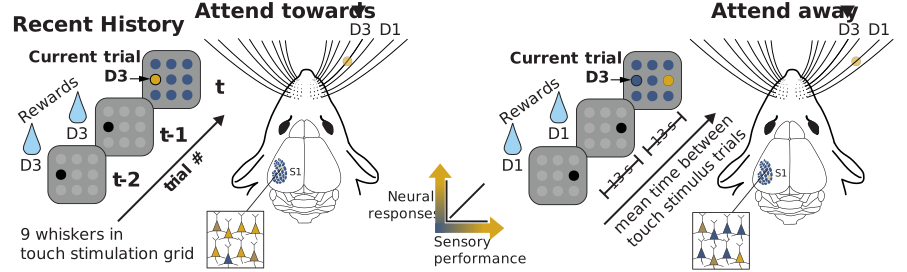
In mice, the arrangement of whiskers on the face corresponds to a clearly defined anatomical map in primary somatosensory cortex (S1). This precise anatomical organization allows us to visualize the attentional “spotlight” at cellular resolution, revealing how attention selectively modulates neural responses to touch.
We combine quantitative behavioral methods, computational modeling, and modern genetic tools with two-photon calcium imaging, extracellular recordings, and optogenetics in behaving mice. These approaches allow us to record neuronal dynamics and manipulate specific cell types to examine how neural circuits mediate perception and attention.
Current Research
Our ongoing projects examine how distinct classes of local interneurons and neuromodulatory inputs contribute to attentional modulation in sensory cortex.
Our research is supported by the NIH BRAIN Initiative, the Brain & Behavior Research Foundation (BBRF), and a UC Riverside Regents’ Faculty Fellowship.